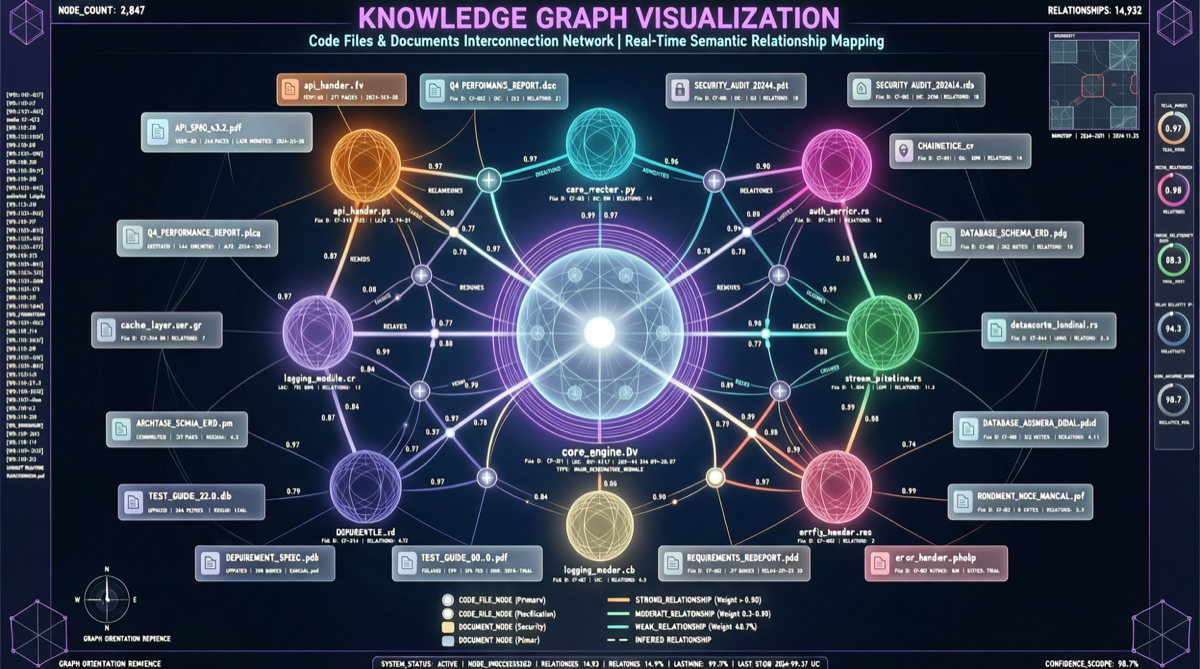
If you have used Claude Code or Cursor on a large project, you have likely encountered this scenario: the AI assistant is completely unfamiliar with a module and requires re-explaining context in every conversation. Graphify attempts to solve this structural problem with knowledge graphs.
The Problem It Solves
Graphify is a Python project (MIT license) whose core function is to automatically convert any folder—code, documents, papers, even images and videos—into a queryable knowledge graph, and register it as a "skill" for mainstream AI coding assistants.
Maintained by safishamsi, the project has gained 37,989 stars and 4,199 forks as of April 29, just about a week after creation. This growth rate is rare among open-source AI tools.
How It Works
Graphify's architecture has two layers:
Construction Layer: Scans the target folder, uses LLMs to extract entities, relationships, and hierarchical structures, and stores them in a graph database. Unlike chunk-level retrieval in vector databases, the knowledge graph preserves explicit connections between concepts—function call chains, document references, topic associations.
Query Layer: Registers as a skill in AI coding assistants. Supported platforms include Claude Code, Codex, Cursor, Gemini CLI, GitHub Copilot CLI, OpenClaw, Factory Droid, Trae, and Google Antigravity. When the AI assistant needs to understand codebase structure, it queries the graph for structured context rather than relying on pure text similarity matching.
Versus Traditional RAG
| Dimension | Vector Search RAG | Graphify Knowledge Graph |
|---|---|---|
| Retrieval Unit | Text chunks | Entities + relationships |
| Multi-hop Queries | Difficult, requires multiple retrievals | Native support |
| Structure Awareness | None, loses code hierarchy | Preserves function/module/doc hierarchy |
| Best For | Single fact lookups | Cross-document/cross-module analysis |
FalkorDB's recent GraphRAG-Bench test also validates this trend: graph-structured RAG significantly outperforms traditional vector retrieval in multi-hop reasoning tasks. Graphify's direction aligns with these evaluation results.
Quick Start
git clone https://github.com/safishamsi/graphify.git
cd graphify
pip install -r requirements.txt
python graphify.py --input /path/to/your/project
The project updates frequently (pushes as recent as April 29) and has high community activity. The MIT license permits commercial use.
Points to Watch
- Accuracy and speed of graph construction on super-large codebases (million-line level) remains to be verified
- Entity-relation extraction relies on LLMs, so cost and quality depend on the underlying model
- Comparative evaluations against GraphRAG SDK, Neo4j, and similar solutions have not yet appeared
For developers who frequently need AI assistants to understand complex codebases, this is a tool worth trying immediately.