Bottom Line Up Front
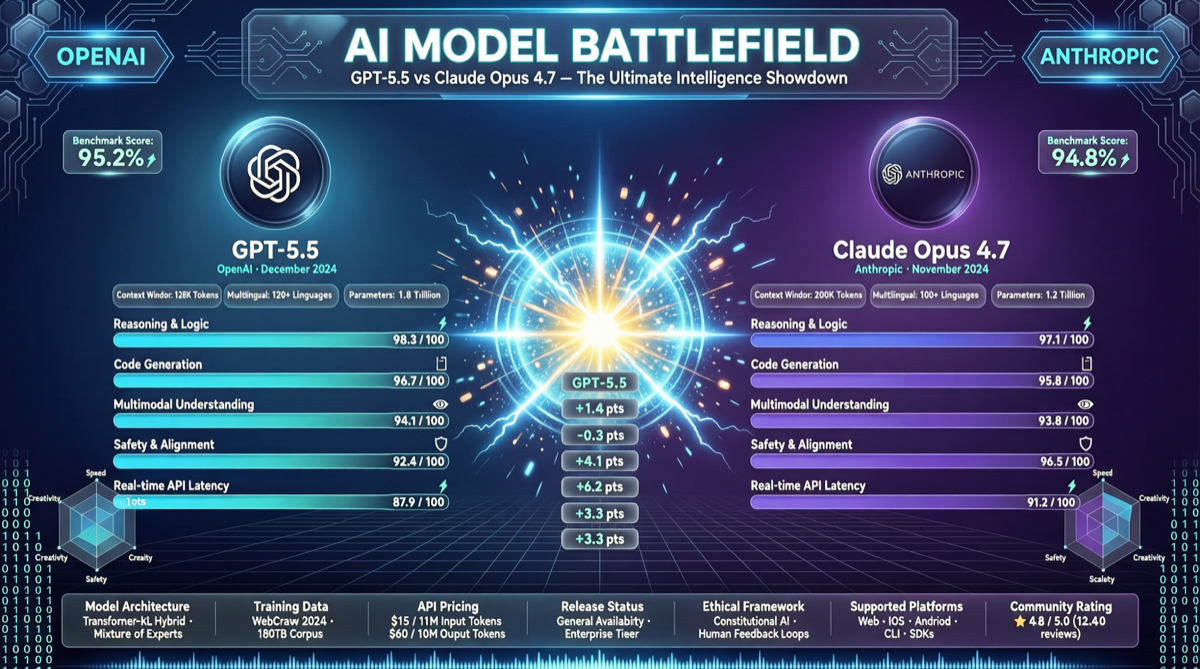
GPT-5.5 (released April 23) and Claude Opus 4.7 (released April 16) are currently the two strongest frontier models, but each has clear advantage zones: Claude Opus 4.7 leads in advanced code engineering and precise instruction following, while GPT-5.5 dominates in long-context understanding and agentic workflows. The question isn’t “which is stronger” but “which fits your task.”
Benchmark Comparison
| Dimension | Claude Opus 4.7 | GPT-5.5 | Gap |
|---|---|---|---|
| SWE-bench Pro | 64.3% | 58.6% | Claude +5.7% |
| HLE (no tools) | 46.9% | 41.4% | Claude +5.5% |
| MRCR @ 1M context | 32.2% | 74% | GPT +41.8% |
| MLE-Bench | — | 36% | GPT only |
| Terminal-Bench 2.0 | — | 82.7% | GPT only |
| Price (per M tokens) | Input $5 / Output $25 | Pro $180/M | Different口径 |
Claude Opus 4.7 leads GPT-5.5 by 5.7% on SWE-bench Pro, the core metric for code engineering capability. GPT-5.5 improved over GPT-5.4 (57.7%) but by a modest margin. On HLE (Humanity’s Last Exam, no-tools version), Claude similarly leads 46.9% to 41.4%.
GPT-5.5 strikes back on MRCR million-context retrieval: 74% vs 32.2%, nearly double. This means in scenarios requiring processing of ultra-long documents, codebases, or datasets, GPT-5.5’s context capability is significantly stronger.
Early Tester Feedback
Claude Opus 4.7 early testers reported three key improvements:
- Self-correction: The model catches logical flaws during the planning phase, not after execution.
- Tool call stability: Notion’s team reported tool errors reduced to one-third of Opus 4.6, with the ability to push through tool failures.
- Instruction precision: Harvey’s legal team scored 90.9% on BigLaw Bench, correctly distinguishing assignment provisions from change-of-control clauses.
GPT-5.5’s advantage lies in agentic workflows: Artificial Analysis Intelligence Index ranks GPT-5.5 (xhigh) at 60 points first, covering the strongest comprehensive performance across 10 standardized benchmarks including coding, math, reasoning, and science.
Selection Guide
| Scenario | Recommendation | Reason |
|---|---|---|
| Complex code refactoring / large repo maintenance | Claude Opus 4.7 | SWE-bench Pro lead, testers report confident autonomous handling of hard tasks |
| Million-context document analysis | GPT-5.5 | MRCR @ 1M nearly doubles Claude’s score |
| Agentic ML engineering automation | GPT-5.5 | MLE-Bench 36%, Terminal-Bench 82.7% |
| Legal / financial document close reading | Claude Opus 4.7 | BigLaw Bench 90.9%, verified instruction precision |
| Daily conversation and creative writing | Either | LMArena Elo scores close (Opus 4.7: 1494, GPT-5.4-high: 1481) |
Landscape Assessment
April 2026 is the densest model release month yet: Claude Opus 4.7, GPT-5.5, DeepSeek V4, Kimi K2.6, and Qwen 3.6 series all launched together. The gap between frontier models is narrowing—no single player can “dominate across the board.” For developers, a multi-model architecture (GPT-5.5 for long-context and agent tasks, Claude Opus 4.7 for code and close reading) is becoming the optimal approach.