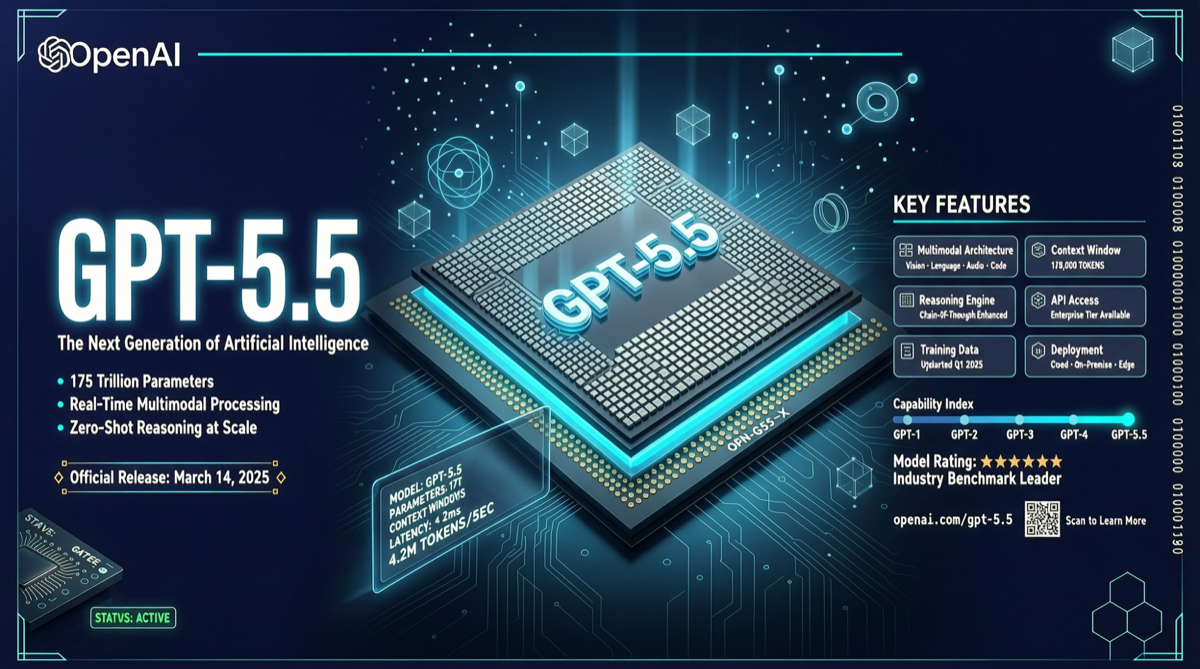
On April 23, 2026, OpenAI officially released GPT-5.5, the first public version featuring its new “Spud” pre-training architecture. In the early hours of the same day, DeepSeek also unveiled V4. The two models landing in the same window perfectly illustrates two divergent paths in the current LLM market: OpenAI bets on high-price, high-performance, while DeepSeek pushes open-source cost-efficiency.
Key Changes
GPT-5.5 is explicitly positioned for complex tasks: cross-tool collaboration in coding, research, and data analysis. According to SemiAnalysis evaluations, GPT-5.5 has reached SOTA-level performance on multiple frontier benchmarks, particularly in self-checking code iteration and deep research assistance.
| Dimension | GPT-5.4 | GPT-5.5 | Change |
|---|---|---|---|
| Input price ($/M token) | 2.5 | 5 | +100% |
| Output price ($/M token) | 15 | 30 | +100% |
| GPT-5.5 Pro input ($/M token) | — | 30 | New tier |
| GPT-5.5 Pro output ($/M token) | — | 180 | New tier |
| Availability | Plus, Pro, Business, Enterprise | Same | Unchanged |
The price doubling is the most striking aspect of this release. Standard edition input pricing went from $2.5/M to $5/M, output from $15/M to $30/M. The new GPT-5.5 Pro tier reaches $30/M input and $180/M output.
Same-Day Competitor: DeepSeek V4
On the very same day, DeepSeek V4 went live. V4’s key selling points are a 1M context window, enhanced Agent capabilities, and KV cache usage reduced to one-tenth of the previous generation. Developers who switched report monthly bill reductions of up to 90%.
Comparative testing is revealing: on gem puzzle reasoning, GPT-5.5 solved it immediately while V4 needed a few more minutes but arrived at the same answer. On IMO final problems, 5.5 took about 3 minutes while V4 produced proofs after longer reasoning. In visualization tasks, V4 handles intro pages more smoothly, while 5.5 dominates at building 3D game sites.
Landscape Assessment
OpenAI’s decision to raise prices rather than lower them signals a strategy of creating performance distance from open-source models, focusing on high-value scenarios where latency and accuracy are critical. But this carries risk: when models like DeepSeek V4 are already “good enough” for most daily tasks, pricing at $30/M output may push many mid-size developers toward cheaper alternatives.
DeepSeek V4’s open-source release reinforces its role as the “cost pressure transmitter” — it doesn’t need to beat GPT-5.5 on every dimension, only to convince most users that the price-performance ratio is sufficient.
Action Recommendations
- Heavy coding/research workloads: If budget allows, GPT-5.5’s self-checking and complex task handling show real perceptual differences worth testing in critical pipelines.
- Daily development and batch tasks: DeepSeek V4’s cost advantage is significant — a 90% bill reduction means even with slightly lower quality, overall ROI may be higher.
- Wait-and-see: The actual cost impact of doubled pricing needs verification in your own workflow. Run small-scale comparison tests before deciding on migration or renewal.